This message includes the following:
- Week at a Glance
- Good Samaritan Apostolate: Life File
- Life File Form
- Youth Formation
- Family Formation
- All Saints Trunk or Treat
- Weekly Activity Lists
- Religious Education No Meeting Fall Festival Weekend
- Called to Pray
- Adult Formation: Class Change
- Celebrate St .Francis
- Library Hours
- How to Donate
- Donation Wish List
- Summer Reading List
- Fall Festival
- In Need of Donations
- Calling Crafters
- Calling Gardeners
- Faith Booth Volunteers
- Parish Leader Meeting
- Landings
- That Man is You
- Grace Force
- New Bible Study
- Care For Creation
- Anxiety and Depression Support Group Not Meeting Monday
- Adoration
- Mahjong Meeting Change
- Justice and Mercy
- Forgiveness
- 10 Reasons Against the Death Penalty
- Prayer Request
- Humane Vitae
- Life Chain
- National Day of Remembrance
- Welcome to the Year of Mission
- Rachels Vinyard
- Prayer of Consecration
Calendar
Saturday, September 7:
- 3:50 Rosary
- 4:30 Mass
- 6:30 Spanish Mass
Sunday, September 8:
- 8:30 Mass
- 9:45 Religious Education
- 11:00 Mass
Monday, September 9:
- 9:00 Communion Service
- 11:00 Walking Together Support Group Room 11
- 1:00 Mahjongg Marian Hall
Tuesday, September 10:
- 9:00 Trailer Tuesday
- 12:00 Communion Service
Wednesday, September 11:
- 10:00 Adult Formation
- 11:30 Divine Mercy Chaplet
- 12:00 Communion Service
- 6:00 Communion Service
- 6:00 That Man is You Marian Hall
- 6:00 OCIA Conference Room
- 6:30 Confirmation Prep
Thursday, September 12:
- 9:00 Communion Service
- 10:00 SVDP
- 5:00 Knights of Columbus Meeting Marian Hall
Friday, September 13:
- 9:00 Communion Service
- 10:00 Sisters in Faith
- 4:00 Grace Force Marian Hall
Adoration Hours
- MONDAY:9:45 AM to 11:00 AM
- WEDNESDAY:12:45 PM to 2:00
- FRIDAY:9:45 AM to 11:00 AM
- Second Sunday from 2-4
There will be a Funeral Mass for Geraldine Shane this Friday, September 6th at 11:00.
Normal Daily Masses will be Communion Services the week of September, 9th through the 13th.
Good Samaritan Apostolate - Life File
Life File and the resource guide will be valuable whenever there is an emergency. We pray for no emergencies, however, letting Life File speak for us when we are unable, could save our lives. This program is for all residents of Towns and Union counties. It is endorsed by both county governments, as well. Forms may also be obtained by printing the PDF file link located on the parish website and/or Facebook page.

If you would like to download and fill out the form at home for Life File, you can find it linked below!


Family Faith Formation
Weekly Activity Prompts
September 8- 23rd Sunday in OT and Nativity of the Blessed Virgin Mary- Read the Gospel as a family and reflect with these questions:
- Imagine you are the man in the story. What is it like to encounter Jesus so intimately?
- Consider the people who brought the deaf man to Jesus. How are we called to be like them?
- Why do you think Jesus told the crowd not to tell anyone about the healing?
September 9- Family Prayer- 5 Finger Prayer- We hear in Sunday’s Gospel of Jesus using his finger to heal the deaf man. Pope Francis created a 5-Finger prayer where each finger has a specific intention. Name the intention for that finger and then allow family members to share any intentions they have in that area.
- Thumb: Pray for those closest to you.
- Index Finger: Pray for those who heal, instruct, and teach you, that God may help them as they direct others.
- Middle Finger: Pray for those in authority, like our government leaders, that God may guide them.
- Ring Finger: Pray for the weak among us—the poor, the sick, the excluded, and those facing other difficulties.
- Pinkie Finger: Pray for yourself. It is easier to pray for your needs once you have prayed for the other four areas.
September 10- Find a new way to pray at dinnertime! Family life is very busy. Sometimes, the best time we get together is at mealtime! Try to find a way to strengthen your family mealtime prayers. This article from Loyola Press offers some suggestions: https://www.loyolapress.com/catholic-resources/family/family-faith-and-fun/family-mealtime/devotion-rediscovered-meal-prayer/
September 11- Family Challenge- Look for opportunities this week to defend someone who is being treated unfairly.
September 12- Feast of the Most Holy Name Of Mary- Today is the day to celebrate all the names of Mary! Pray the Litany of Mary as a family together today. https://colonialmexico.blogspot.com/2014/08/litany-of-loreto-latinenglishspanish.html
September 13- Have a family movie night! Whether you pick something from FORMED, or choose a family favorite, a family movie night is a fun way to end your week. Pick a yummy snack and enjoy time together.
September 14- Exaltation of the Holy Cross- When living the liturgical year at home, celebrating the exaltation of the holy cross with kids is a fun feast day to keep in mind! The cross image lends itself to all kinds of fun crafts and activities, and this is also a great time to talk to kids about what exalting something really means. Find some suggestions for celebrating this feast at Catholic Icing: https://www.catholicicing.com/celebrating-the-exaltation-of-the-holy-cross-with-kids/
All Saints Trunk or Treat
All Saints Trunk or Treat will be Sunday, November 3rd from 4-6 PM! We will be in the upper parking lot. Please consider decorating your trunk as a Bible, Catholic, or Saint theme. Please contact Ashley Shepherd for more information and decorating ideas at familyformation@stfrancisblairsville.com.
No Religious Education Classes the Weekend of the Fall Festival
There will be No Religious Education Classes the weekend of the Fall Festival.
Called to Pray
Prayer is the foundation of praise and thanksgiving, the path to spiritual
growth and, along the way, to maturity in how to pray. You are invited to
attend Fire of the Spirit Prayer meetings on the 1 st and 3 rd Wednesdays of
each month – Room 5 from 10:00-11:30 AM. . For more information,
contact: adultformation@stfrancisblairsville.com
Adult Faith Formation Class Changes
Adult Formation will be changed from Saturdays in Rm5 to the second and fourth Wednesday of the month. This will coincide with the Prayer Ministry that meets on the first and third Wednesday of the month. All will meet starting at 10am.
CLELBRATE ST. FRANCIS!
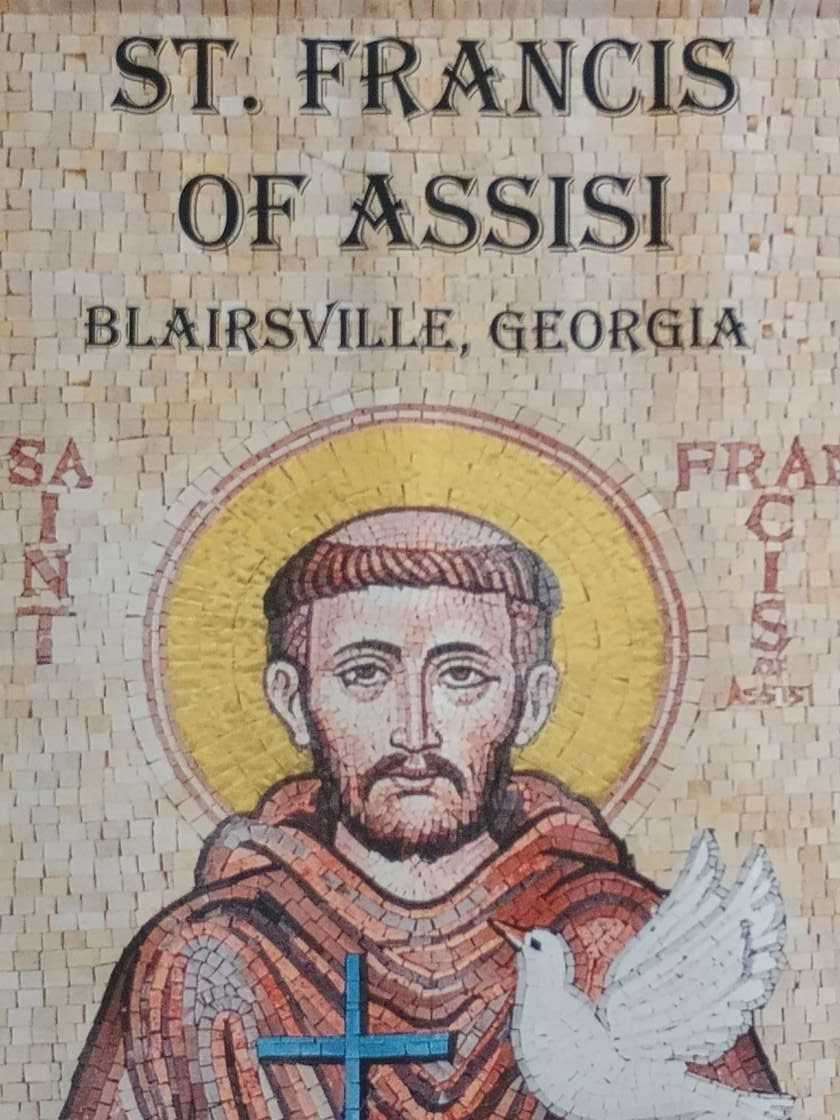
The feast day of our patron saint, St. Francis of Assisi, will be celebrated October 2nd to the 4th . Several parts of the celebration will be new to most people, but we encourage everyone to come and learn more about St. Francis and his life.
Beginning on September 15th , we will begin collecting pet food for the local animal shelter(s). Collection boxes for the pet food. will be in the narthex of the church. On October 2 nd , at 6pm in the evening, there will be a Mass and the “Blessing of the Pets”. Everyone is encouraged to bring “Fluffy” and “Fido” to receive a blessing for them.
October 3 rd will be the Transitus of St. Francis. Beginning at 4pm in the church will be service that memorializes the passing of St. Francis as he welcomes “Sister Death”. Secular Franciscans from the Fraternity of the Franciscan Martyrs of
Siroki Brejig (our local fraternity) will be available before and after the service to answer any questions regarding the Transitus, or if you would like to know more about becoming a Secular Franciscan. October 4 th is the actual feast day of St. Francis. We will begin with a Mass at noon that will be followed by a luncheon in
Marian Hall. A slide presentation about Assisi, Italy will be ongoing during the luncheon. Following lunch, everyone is invited to return to the church where a presentation will be offered regarding the San Damiano Cross. The cross was
painted by our own Franciscan, Nancy Hazlip, who will recount for us the trials and triumphs of painting this cross for our parish. If you have ever wondered about all the interesting parts of this cross, this will be the perfect opportunity to learn about
this special painting and the artist. PLEASE put these dates on your calendar!!!
Library Hours
The new library has new hours. The library will be open Monday, Wednesday, and Thursday from 10am to noon. Other hours by request. A list of books on our “wish list” will be available on the door, if anyone wishes to make a donation. Any new books donated will have a bookplate placed inside the cover with the donor’s name added.
Donations of NEW BOOKS may be made by purchasing new editions from our Wish List or by making a monetary donation. All donors will have a bookplate in the front of the new book(s) with their name on it in appreciation of their gift.
Library Wish List
-We would like to thank those people who have, recently, made donations to the library. The new books are greatly appreciated. Here are some additional suggestions:a. The Man Who Would Be Thursday by G.K. Chesterton
b. Any of the Fr. Brown Mysteries also by G.K. Chesterton
c. Catechism of the Spiritual Life by Robert Cardinal Sarah
d. The Life Edith Stein; A Philistine and a Carmelite by Teresa Passett
A reminder that we would like hardbound copies, if possible, of all donated books. Anyone making a donation will have a bookplate in the book with the donor's name.
b. Any of the Fr. Brown Mysteries also by G.K. Chesterton
c. Catechism of the Spiritual Life by Robert Cardinal Sarah
d. The Life Edith Stein; A Philistine and a Carmelite by Teresa Passett
A reminder that we would like hardbound copies, if possible, of all donated books. Anyone making a donation will have a bookplate in the book with the donor's name.
Summer Reading List
To add to your summer reading list are two relatively short books for you to enjoy.
1. God Is Ever New; Meditations on Life, Love, and Freedom by Pope Benedict XVI. These short meditations are a great way to either start or end your day. Each is not a lengthy theological dissertation, but is intended to draw you into a closer relationship with God as well as instruct.
2. Trusting God in the Present by Fr. Jacques Philippe. There is a lot packed into this short, 50 page, book. There are many times that circumstances can overwhelm us and, in trying to make the right decisions, we often leave God out. In challenging and difficult times, we need God more than ever to help lead us and show us the right things to do. This book is a great place to start trusting in God, Who always has the perfect answers.
3. "Then Peter Stood Up..." A Collection of the Pope's Addresses to the Catholic Charismatic Renewal --
If you are unsure of the Charismatic Renewal actually being "Catholic", this book is a great place to gain an understanding of how the Holy Spirit is truly at work in the Church and in the world. The Charismatic Renewal is not a bunch of snake oil salesmen but instead it is proof that the Holy Spirit is as active as He ever was from the establishment of the Church to the present day. An interesting read for summer
4. "Rescued --the Unexpected and Extraordinary News of the Gospel" by Fr. John Ricardo
1. God Is Ever New; Meditations on Life, Love, and Freedom by Pope Benedict XVI. These short meditations are a great way to either start or end your day. Each is not a lengthy theological dissertation, but is intended to draw you into a closer relationship with God as well as instruct.
2. Trusting God in the Present by Fr. Jacques Philippe. There is a lot packed into this short, 50 page, book. There are many times that circumstances can overwhelm us and, in trying to make the right decisions, we often leave God out. In challenging and difficult times, we need God more than ever to help lead us and show us the right things to do. This book is a great place to start trusting in God, Who always has the perfect answers.
3. "Then Peter Stood Up..." A Collection of the Pope's Addresses to the Catholic Charismatic Renewal --
If you are unsure of the Charismatic Renewal actually being "Catholic", this book is a great place to gain an understanding of how the Holy Spirit is truly at work in the Church and in the world. The Charismatic Renewal is not a bunch of snake oil salesmen but instead it is proof that the Holy Spirit is as active as He ever was from the establishment of the Church to the present day. An interesting read for summer
4. "Rescued --the Unexpected and Extraordinary News of the Gospel" by Fr. John Ricardo
5. Catechism of the Spiritual Life by Robert Cardinal Sarah.
The spiritual life requires a "guide" to help us discern the decisions that we are constantly bombarded with every day. In centuries past, we've had St Teresa of Avila and St John of the Cross; often difficult to understand and even more difficult to follow. Cardinal Sarah's book helps guide us by means of a sacramental life and learning how to truly and sincerely follow Jesus. Not an easy read, but a necessary one.
6. Christendom Lost and Found by Fr Robert McTeigue, S.J.
This book of meditations addresses what, many Christians feel, has been an ongoing attack on Christianity through culture. How do we navigate that? Do we feel like the "remnant" spoken of in Scripture? If the goings on of the world are causing anxiety and depression, these meditations may be just the hope you need.
With so much doubt and uncertainty in the world and so many things pointing us down the wrong path, everyone needs to read a book like this. We have been given the Best News ever! But do we believe it? If you're going to read one book this summer, this needs to be it.
The spiritual life requires a "guide" to help us discern the decisions that we are constantly bombarded with every day. In centuries past, we've had St Teresa of Avila and St John of the Cross; often difficult to understand and even more difficult to follow. Cardinal Sarah's book helps guide us by means of a sacramental life and learning how to truly and sincerely follow Jesus. Not an easy read, but a necessary one.
6. Christendom Lost and Found by Fr Robert McTeigue, S.J.
This book of meditations addresses what, many Christians feel, has been an ongoing attack on Christianity through culture. How do we navigate that? Do we feel like the "remnant" spoken of in Scripture? If the goings on of the world are causing anxiety and depression, these meditations may be just the hope you need.
With so much doubt and uncertainty in the world and so many things pointing us down the wrong path, everyone needs to read a book like this. We have been given the Best News ever! But do we believe it? If you're going to read one book this summer, this needs to be it.
Fall Festival Dates!
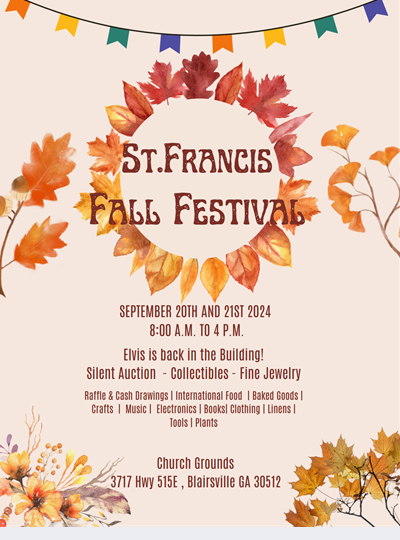
In Need of Donations for the Fall Festival!
We are in need of donations for the Fall Festival! We are down about 50% since last year. Please rummage through your goods and donate Tuesday. This is our last day for donations prior to the festival. Thank you all for your generosity and support.
Attention Fall Festival Crafters
Any person who is donating hand-made items to be sold at the festival must price and bring them into Marian Hall by the week of by September 15th.
Fall Festival Gardeners
Calling All Gardeners! We are in need of donated plants for the Garden venue at the Fall Festival. Please keep them and tend to them as the drop off date will be on September 19th outside the meeting house. We will accept both indoor and out door plant dona tions. We can’t wait to see what beautiful plants you all have grown!
Faith Booth Volunteers
This year the "Faith" booth at the fall festival will promote Life File to the community. While this is secular endeavor, as part of the Good Samaritan Apostolate, we need to promote this to the community, our neighbors. Anyone able to give one hour during either of the 2 days of the festival to please contact Linda McKnight, Office of Adult Faith Formation, to sign up. Materials for the "Faith" part of our apostolate will also be available during the festival.
Landings
Do you know someone who…
“used to be a Catholic”? Or are you looking to rekindle or refresh your own Faith
journey? Maybe it’s time to explore the Landings program at St. Francis.
Landings is not a class; it is not a discussion group; it is not some kumbaya feel
good get together thing. Landings is a journey in Faith, guided by the Holy Spirit.
Landings offers an opportunity to re-explore your Catholic Faith and be
re-introduced to the love of Christ, in a supportive and confidential setting.
If you, or someone you know, is interested re-exploring your Catholic faith, or
if would just like more information, please contact Rick Caauwe at 912-230-4961.
Landings.SFA@gmail.com Or, just complete one of the pew cards.
Our next session begins on Thursday October 3rdh at 6pm.
Pre-registration is required.
THAT MAN IS YOU (TMIY)
All Men Are Invited – Catholic and Non-Catholic
TMIY at St. Francis of Assisi starts gathering again on Wednesday’s beginning August 14, 2024 in Marian Hall at 6:30 p.m. We encourage everyone to arrive around 6 p.m. or shortly thereafter. Our third year of the TMIY program will be based on “The Fight of Faith” and will contain twenty-eight weeks divided into two fourteen week semesters, Fall ( Aug 14 – Nov 13) & Spring (Jan 22 – Apr 23), featuring ten dynamic presenters.
After Mass for the first two weekends of August (8/03-04 and 8/10-11), a TMIY
information table will be manned for your convenience to answer questions and offer
additional information. There’s no required commitment, no specified obligations, just stop by and inquire about the program.
This program is truly beneficial for men of all ages - No matter where you are in your
spiritual life, young or older, Jesus wants to encounter YOU right there and take you further - if you let him!
Those of you who have attended SFA TMIY this past year are automatically included in this Fall Semester and will receive email’s pertaining to the program. We still encourage you to stop by the information table and pick up a new brochure while chatting with your Brothers in Christ.
“Iron Sharpens Iron, and One Man Sharpens Another.”
(RSV 2 nd CE) Prov 27:17
THAT MAN IS YOU (TMIY)
All Men Are Invited – Catholic and Non-Catholic
TMIY at St. Francis of Assisi starts gathering again on Wednesday’s beginning August
14, 2024 in Marian Hall at 6:30 p.m. We encourage everyone to arrive around 6 p.m.
or shortly thereafter. Our third year of the TMIY program will be based on “The Fight of
Faith” and will contain twenty-eight weeks divided into two fourteen week semesters,
Fall ( Aug 14 – Nov 13) & Spring (Jan 22 – Apr 23), featuring ten dynamic presenters.
After Mass for the first two weekends of August (8/03-04 and 8/10-11), a TMIY
information table will be manned for your convenience to answer questions and offer
additional information. There’s no required commitment, no specified obligations, just
stop by and inquire about the program.
This program is truly beneficial for men of all ages - No matter where you are in your
spiritual life, young or older, Jesus wants to encounter YOU right there and take
you further - if you let him!
Those of you who have attended SFA TMIY this past year are automatically included in
this Fall Semester and will receive email’s pertaining to the program. We still encourage
you to stop by the information table and pick up a new brochure while chatting with your
Brothers in Christ.
“Iron Sharpens Iron, and One Man Sharpens Another.”
(RSV 2 nd CE) Prov 27:17
All Men Are Invited – Catholic and Non-Catholic
TMIY at St. Francis of Assisi starts gathering again on Wednesday’s beginning August
14, 2024 in Marian Hall at 6:30 p.m. We encourage everyone to arrive around 6 p.m.
or shortly thereafter. Our third year of the TMIY program will be based on “The Fight of
Faith” and will contain twenty-eight weeks divided into two fourteen week semesters,
Fall ( Aug 14 – Nov 13) & Spring (Jan 22 – Apr 23), featuring ten dynamic presenters.
After Mass for the first two weekends of August (8/03-04 and 8/10-11), a TMIY
information table will be manned for your convenience to answer questions and offer
additional information. There’s no required commitment, no specified obligations, just
stop by and inquire about the program.
This program is truly beneficial for men of all ages - No matter where you are in your
spiritual life, young or older, Jesus wants to encounter YOU right there and take
you further - if you let him!
Those of you who have attended SFA TMIY this past year are automatically included in
this Fall Semester and will receive email’s pertaining to the program. We still encourage
you to stop by the information table and pick up a new brochure while chatting with your
Brothers in Christ.
“Iron Sharpens Iron, and One Man Sharpens Another.”
(RSV 2 nd CE) Prov 27:17
Grace Force
Rick Caauwe will be presenting this Friday September 6th. Rick will introduce and inspire us to try another form of contemplative prayer called “Visio-Divina”
We meet at 4;00 in conference room 5 Come early for coffee, snacks, and fellowship.
Next Friday September thirteenth Betty Mendenhall is presenting on the life and Spirituality of Edith Stein
New Bible Study
We will be starting September 30th, With the Book of Tobit. Classes will be at 10 am and Zoom at 7pm For more information please contact Paul Sanfilippo by email (pbsanf@gmail.com) or Linda McKnight (adultformation@stfrancisblairsville.com).
Care for Creation
Books, puzzles, and games – Oh My! There will be plenty of all three of these available in the Book Tent at the Fall Festival. Buying these at the festival is good in three ways. 1) you save money compared to buying new ones – lots of money! 2) Buying used saves the need to produce more new items. 3) Buying used keeps the books, puzzles and games out of the landfill.
Remember to save them and donate them back for next year’s festival after you use them!
Remember to save them and donate them back for next year’s festival after you use them!
Adoration
Won’t you sit with
me for just one hour?”
Join your St. Francis family in Adoration of
the Blessed Sacrament on Sunday Sept.8th
from 2pm to 4pm.
Mahjong Meeting Changes
Mah Jongg has been changed to Monday afternoons in Marian Hall from 1-3:30. Please come and share in the fellowship. There will be players on hand that can teach as well.
Sisters in Faith September Meeting (September 13)
)Sisters in Faith is a gathering of women from different churches who come together to share their faith and grow spiritually. Meetings are on the second Friday of each month in Marian Hall. The next meeting is on Friday, September 13, from 10:00-12:30. The topic for the month is Spiritual Companionship: How can we walk with others in their spiritual journey? Come with a friend or come alone and make a friend. Contact Colleen Orchanian for more information (colleenorchanian@gmail.com).
Justice and Mercy
Justice and Mercy Ministry, an article from Catholic Mobilizing Network:
Top 5 Myths About Forgiveness: A Catholic Perspective #4
As Catholics, we understand that there is a Gospel call toward forgiveness — yet
forgiveness is never an obligation, but a creative act of possibility and grace.
Together, we can work to dispel common myths about forgiveness and open up
new possibilities for reconciliation and healing.
Over the last few weeks, we have been sharing with you what these 5 myths are. Here
is Number Four:
Myth #4: Forgiveness demeans victims of harm or negates the harm done to them.
Forgiveness is compatible with seeking justice for the survivors of wrongdoing and does not negate their pain and suffering. Forgiveness is not demeaning but a free choice by the survivor, through which survivors reclaim personal agency and redefine their relationship to the past. As Pope Francis explains, “Free and heartfelt forgiveness is something noble, a reflection of God’s own infinite ability to forgive. . . Those who truly forgive do not forget. . . They break the vicious circle; they halt the advance of the forces of destruction.”
(Fratelli Tutti, 250-251)In justice, no one can or should be forced to forgive, and no other person can justly forgive on behalf of victims.
Top 5 Myths About Forgiveness: A Catholic Perspective #4
As Catholics, we understand that there is a Gospel call toward forgiveness — yet
forgiveness is never an obligation, but a creative act of possibility and grace.
Together, we can work to dispel common myths about forgiveness and open up
new possibilities for reconciliation and healing.
Over the last few weeks, we have been sharing with you what these 5 myths are. Here
is Number Four:
Myth #4: Forgiveness demeans victims of harm or negates the harm done to them.
Forgiveness is compatible with seeking justice for the survivors of wrongdoing and does not negate their pain and suffering. Forgiveness is not demeaning but a free choice by the survivor, through which survivors reclaim personal agency and redefine their relationship to the past. As Pope Francis explains, “Free and heartfelt forgiveness is something noble, a reflection of God’s own infinite ability to forgive. . . Those who truly forgive do not forget. . . They break the vicious circle; they halt the advance of the forces of destruction.”
(Fratelli Tutti, 250-251)In justice, no one can or should be forced to forgive, and no other person can justly forgive on behalf of victims.
10 reasons to end the death penalty
10 reasons to end the death penalty - Internationally. ( worldcoalition.org )
1.No State (country) should have the power to take a person’s life.
2. It is irrevocable. No justice system is safe from error and innocent people are likely to be.
sentenced to death or executed.
3. It is unfair.The death penalty is discriminatory and is used disproportionately against people
from disadvantaged socioeconomic backgrounds, people with intellectual or psychosocial
disabilities, and members of racial and ethnic minority groups. In some countries, the death
penalty is used to target groups on the basis of their sexual orientation, gender identity,
political opinion, or religion.
4. It is inhuman, cruel, and degrading. Conditions on death row and the anguish of facing
execution inflict extreme psychological and physical suffering, and execution is a physical and
mental assault.
5. It denies any possibility of rehabilitation.
6. It is applied overwhelmingly in violation of international standards. It breaches the principles
of the 1948 Universal Declaration of Human Rights, which states that everyone has the right to
life and that no one shall be subjected to torture or to cruel, inhuman or degrading treatment or
punishment. On nine occasions, the United Nations General Assembly has called for the
establishment of a moratorium on the use of the death penalty (resolutions No. 62/149 in 2007,
No. 63/168 in 2008, No. 65/206 in 2010, 67/176 in 2012, No. 69/186 in 2014, No. 71/187 in
2016 and No. 73/175 in 2018 and No. 75/183 in 2020 and No. 77/222 in 2022).
7. It creates unjustifiable pain for everyone in contact with it: particularly the relatives of both
victims and people sentenced to death, including children, with harsh transgenerational
consequences.
8. It is counterproductive, because killing of a human being as a criminal justice solution
endorses murder more than it fights it.
9. It is inefficient and does not keep society safer. It has never been conclusively shown that
the death penalty deters crime more effectively than life imprisonment. On the contrary, studies
show that the rate of the most violent crimes is higher in retentionist countries than in
abolitionist countries.
10. Many murder victims’ families do not want the death penalty. A large and growing number
of victims’ families worldwide reject the death penalty and are speaking out against it, saying it
does not bring back or honor their murdered family member, does not heal the pain of the
murder, and violates their ethical and/or religious beliefs.
sentenced to death or executed.
3. It is unfair.The death penalty is discriminatory and is used disproportionately against people
from disadvantaged socioeconomic backgrounds, people with intellectual or psychosocial
disabilities, and members of racial and ethnic minority groups. In some countries, the death
penalty is used to target groups on the basis of their sexual orientation, gender identity,
political opinion, or religion.
4. It is inhuman, cruel, and degrading. Conditions on death row and the anguish of facing
execution inflict extreme psychological and physical suffering, and execution is a physical and
mental assault.
5. It denies any possibility of rehabilitation.
6. It is applied overwhelmingly in violation of international standards. It breaches the principles
of the 1948 Universal Declaration of Human Rights, which states that everyone has the right to
life and that no one shall be subjected to torture or to cruel, inhuman or degrading treatment or
punishment. On nine occasions, the United Nations General Assembly has called for the
establishment of a moratorium on the use of the death penalty (resolutions No. 62/149 in 2007,
No. 63/168 in 2008, No. 65/206 in 2010, 67/176 in 2012, No. 69/186 in 2014, No. 71/187 in
2016 and No. 73/175 in 2018 and No. 75/183 in 2020 and No. 77/222 in 2022).
7. It creates unjustifiable pain for everyone in contact with it: particularly the relatives of both
victims and people sentenced to death, including children, with harsh transgenerational
consequences.
8. It is counterproductive, because killing of a human being as a criminal justice solution
endorses murder more than it fights it.
9. It is inefficient and does not keep society safer. It has never been conclusively shown that
the death penalty deters crime more effectively than life imprisonment. On the contrary, studies
show that the rate of the most violent crimes is higher in retentionist countries than in
abolitionist countries.
10. Many murder victims’ families do not want the death penalty. A large and growing number
of victims’ families worldwide reject the death penalty and are speaking out against it, saying it
does not bring back or honor their murdered family member, does not heal the pain of the
murder, and violates their ethical and/or religious beliefs.
Justice and Mercy Prayer Request
There will be no ringing of the church bell on Sept 6th due to a parish funeral.
The following men were executed between the First Friday of August and the First
Friday of September. All people are made in the image of God. Please pray for these
men’s souls.
8/7/24 Arthur Lee Burton TX
8/8/24 Taberon Dave homie UT
8/29/24 Loran KentsleyCole FL
The following men were executed between the First Friday of August and the First
Friday of September. All people are made in the image of God. Please pray for these
men’s souls.
8/7/24 Arthur Lee Burton TX
8/8/24 Taberon Dave homie UT
8/29/24 Loran KentsleyCole FL
Humane Vitae
You are invited to join us at the Humanae Vitae Ministry meetings on the 4th Tuesday of each month at 1pm. We hope to see you there!
"God loves each human life from the instant of his or her conception and entrusts this gift to the protection of a mother and father. Abortion ends the life of a child and offends God. It also deeply wounds the women and men involved."
Life Chain
All life is precious and made in God's image. Join others as we stand up for the unborn and their mothers at this year's Blairsville Life Chain on October 6th. Life Chain is the largest pro-life peaceful witness in the world. Over a thousand cities and towns across the US and Canada have participated each year. (Your church/organization) will be participating in the Blairsville Life Chain on HWY 515/76. For more information call Carrie Powers at 706-745-6400.
--
National Day of Remembrance
Please join the Humanae Vitae Ministry on Saturday 9/14 and Sunday 9/15 in-between masses as we pray for National Day of Remembrance of Aborted Children.
Welcome to the Year of Mission
Rachels Vinyard
Rachel's Vineyard Retreat - September 27-29, 2024
Has Abortion affected your life? Are you living with secrecy, shame, and a deep sense of loss in your life because of abortion? You are not alone. Post Abortion Treatment and Healing ("PATH") offers hope and healing.
Registration is currently open for PATH's next Rachel’s Vineyard Retreat, September 27-29, 2024.
Take heart...Jesus is calling.
For more information or to register, please call 404-717-5557. All calls are completely confidential.
Prayer of Consecration Before an Election
Mary Immaculate, living tabernacle of the Divinity, where the eternal Wisdom lies hidden to be adored and served by angels and men, Queen of heaven and of earth, beneath whose sway are subject all things that are lower than God, Patroness of the United States of America, sorrowful and mindful of our own sinfulness and the sins of our nation, we come to Thee, our refuge and hope. Knowing that our country cannot be saved by our own works and mindful of how much our nation has departed from the ways of Thy Son, we humbly ask that Thou wouldst turn Thine eyes upon our country to bring about its conversion. We consecrate to Thee the integrity of the upcoming election and its outcome, so that what is spiritually and morally best for the citizens of our country may be accomplished, and that all of those who are elected would govern according to the spiritual and moral principles which will bring our nation into conformity with the teachings of Thy Son. Give grace to the citizens of this land so that they will choose leaders according to the Sacred Heart of Thy Son, that His glory may be made manifest, lest we be given the leaders we deserve. Trusting in the providential care of God the Father and Thy maternal care, we have perfect confidence that Thou wilst take care of us and will not leave us forsaken. O Mary Immaculate, pray for us. Amen
Last thing: "I used to believe that prayer changes things. Now I believe that prayer changes us and we change things." -- St Mother Teresa of Kalkutta
There will be a Motorcycle Ride and Retreat on Monday, October 4 (weather permitting) beginning at 10:00. We will meet at the church at 10:00 for a short talk and then ride to Dahlonega for lunch and conversation. Then we'll take a leisurely ride back to Blairsville. Total distance for the ride is about 80 miles. Contact Colleen Orchanian for more information at drecolleen@gmail.com or 706.400.9580.
How many people will be attending?
I will be attending by myself (1)
- View Details
I will be attending with another person (2 people)
- View Details
Why Go to Adoration
The Saints that we honor and ask intercession from are the Catholic Church's Hall of Fame. They are proof for us that every Saint had a past and every sinner has a future. If you have a favorite photo, painting, icon of your patron saint and would like to donate it to St Francis, we are creating a "Hall" of Fame in the administration building. Pictures should not exceed 9 x 12 inches in total size, including a frame. Pictures may be delivered to the Adult Faith Formation office.
Did you know we have a Parish Facebook Page? You can follow us at https://www.facebook.com/sfablairsville as another way to stay up to date and engaged with the parish!
Any questions about flocknote? Need help updating your information or being added/removed from groups? Please email communications@stfrancisblairsville.com for assistance!